Hobbing vs Grinding for Gear Finishing: Cycle Time, Cost, and When to Choose Hobbing
When a buyer or process engineer specifies a gear, the finishing method decides both the unit cost and how fast parts come off the machine. Two routes dominate: gear hobbing and gear grinding. Both cut teeth, but they sit at opposite ends of the speed-versus-accuracy trade-off. This article lays out the real numbers so you can pick the right process instead of over-paying for accuracy you do not need.
Two routes, two cost profiles
Hobbing is a generative enveloping process: the hob and the blank rotate in a fixed ratio and the teeth are formed in one continuous cut, rough and semi-finish together. Gear grinding, by contrast, is a finishing operation normally applied after the tooth has already been cut and heat-treated. That single difference drives everything else.
Accuracy you can actually reach
Gear accuracy in China follows GB/T 10095 (equivalent to ISO 1328), graded 0 to 12 where a smaller number is finer. The finishing route sets the ceiling:
| Process route | Achievable grade (ref.) | What it costs |
|---|---|---|
| Hobbing, single operation | Grade 6-7 | Lowest cycle time and tool cost; ceiling set by machine indexing |
| Hobbing + shaving | Grade 5-6 | One extra pass to correct tooth form |
| Hobbing + grinding | Grade 3-5 | Highest cost; reserved for hardened, high-duty teeth |
For grade 6, the acceptance reference values are pitch accumulation at or below 0.012 mm and gear radial runout at or below 0.008 mm. Those numbers are normally reached straight off a rigid hobbing machine with a qualified blank and an AA-class hob, with no grinding needed.
Where hobbing wins on cycle time
Because hobbing completes roughing and finishing in a single setup, its per-part cycle is far shorter than grinding, which must first wait for heat treatment and then remove a controlled stock allowance. On a typical medium-module gear, hobbing can run several times faster than the equivalent grind. For production volumes, that difference is the gap between meeting a delivery date and missing it.
Why a hydrostatic hobbing machine holds the grade
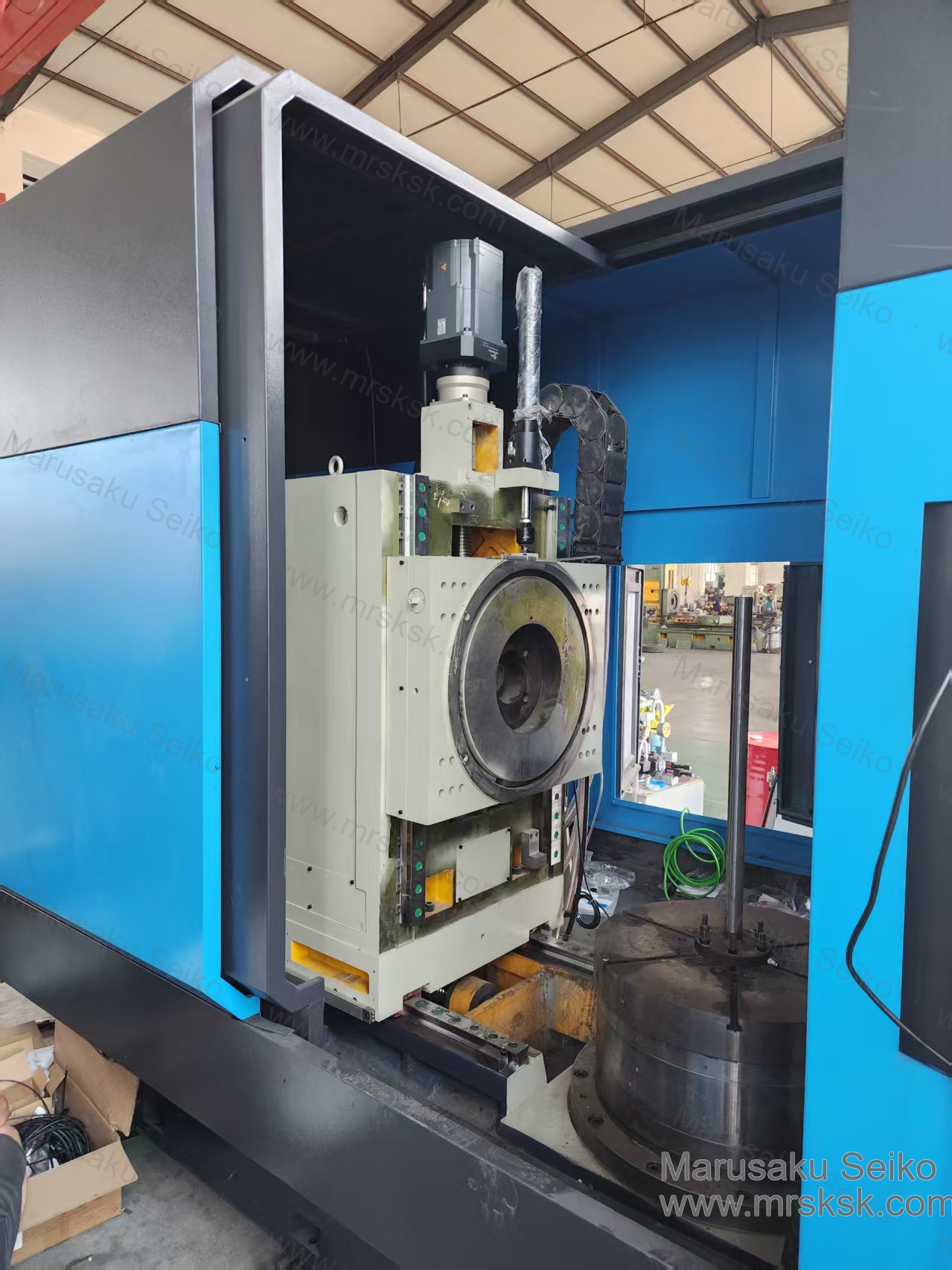
The accuracy a hobbing machine can hold long-term comes down to three things: indexing consistency, vibration damping, and backlash. Marusaku Seiko's dedicated grade-6 hobbing machine addresses each with a hydrostatic rotary table, a hydrostatic tool post, and a direct-drive motor:
- Indexing: a hydrostatic rotary table runs on a zero-clearance oil film with no mechanical wear, so pitch consistency stays stable far longer than with a worm-gear divider.
- Vibration: the hydrostatic tool post's high damping suppresses cutting chatter that would otherwise mark the flank.
- Backlash: the direct-drive motor removes the transmission chain entirely, leaving no backlash for clean bidirectional cutting.
Application sectors
Hobbing at grade 6-7 covers the bulk of industrial demand: wind-power gearboxes, machine-tool transmissions, robot reducers, conveyors, and general power-transmission gearing. Grinding is reserved for the top end, aerospace, precision servo, and hardened high-load teeth that genuinely need grade 3-5.
Choosing the right path
Specify the grade you actually need per GB/T 10095 and stop there. If grade 6-7 is enough, hobbing is almost always the faster and cheaper answer; reserve grinding for the few parts that truly demand it. When you evaluate a hobbing machine, check its indexing accuracy, repeat positioning, and thermal stability, because those determine whether it can hold grade 6 batch after batch.
Marusaku Seiko builds dedicated grade-6 hobbing machines on a hydrostatic platform and supplies both the machines and custom-cut gears. See the gear machining equipment range, review our CNC hobbing machine selection guide, or explore the hydrostatic rotary table that underpins our indexing accuracy. Contact our engineering team for a process recommendation on your part.