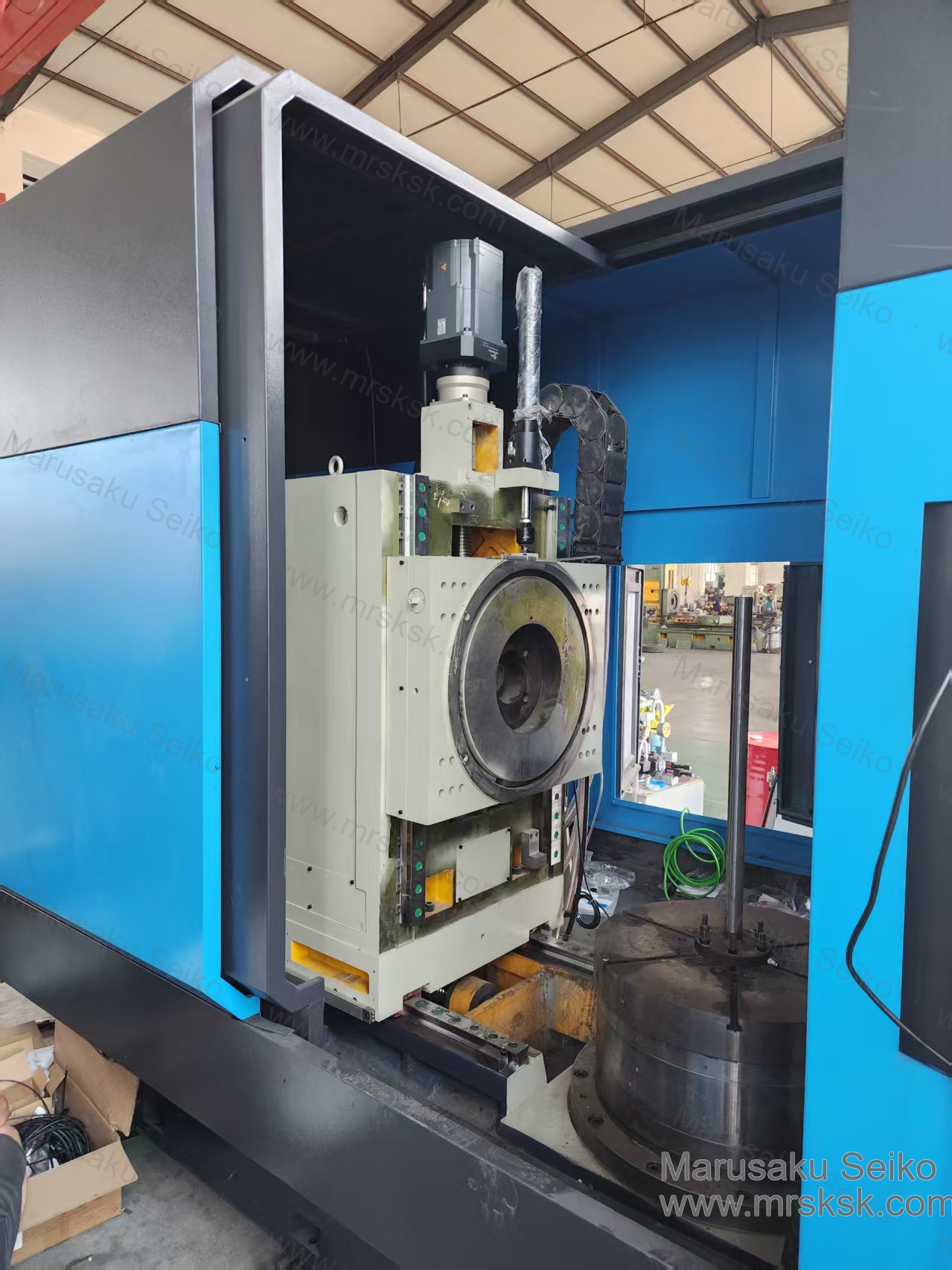
A gear's accuracy grade is printed by the machine, not the hob. The cutter decides the tooth form the machine intended; everything the grade report shows — pitch, profile, helix — is the sum of the machine's own errors at the moment of cut. So when a specification calls for ISO 1328 grade 6, the real question is whether the hobbing machine can hold that geometry through a whole blank, hot and loaded. It usually comes down to five machine behaviors.
The five error sources that become gear errors
- Work-spindle radial and axial runout. Any radial eccentricity of the table writes a once-per-revolution component straight into the gear's total radial runout and pitch. Hydrostatic work spindles hold this to the 0.1 μm class — a radial runout figure that rolling bearings approach only with heroic effort.
- C-axis indexing accuracy. The dividing motion that places each tooth is the single biggest lever on pitch deviation (Fp, fpt under ISO 1328). A direct-drive C-axis with a high-resolution encoder removes gearbox backlash from the loop entirely — the architecture behind the dual hydrostatic hobbing machine.
- Hob-spindle (A/B-axis) runout and swivel repeatability. The hob's own runout transfers to profile and helix; the B-axis (hob swivel) repeatability sets the helix angle. Both want stiffness and no backlash.
- Feed-axis straightness and squareness. These become helix slope errors and taper — invisible on a single tooth, decisive on the grade report.
- Thermal drift. The blank grows, the column grows, the oil warms — and the grade degrades over the first parts of a run. Thermal steadiness is a machine-design property, not an operator trick.
Why hydrostatic support changes the achievable grade
An oil-film work spindle and direct-drive C-axis remove two of the five sources (runout, indexing backlash) at the source, and the film's damping quiets the rest. That is the technical reason a dual hydrostatic hobbing spindle and direct-drive B/C axes reaches ISO grade 6 in one setup where a conventional machine needs finishing passes. The grade is not bought with a finer hob; it is bought with a machine that stops adding its own error.
What the grade report should therefore check
Under the ISO 1328 system the decisive items are total cumulative pitch deviation Fp, single-pitch deviation fpt, profile deviation ffα, helix deviation fHβ and total radial runout Fr. A machine that is strong on runout and indexing will post good Fp, fpt and Fr; one with stiff, damped axes posts good ffα and fHβ. A hobbing-versus-grinding efficiency comparison only means something once both routes are held to the same ISO grade — otherwise you are comparing two different products.
Marusaku Seiko angle
Marusaku Seiko builds gear-hobbing machines around hydrostatic spindles and direct-drive dividing axes for precision gear work — see the precision-for-gear-hobbing rationale and the dual hydrostatic hobbing machine launch. Grade is a machine property; we design for it.